The Verification Gap: Why AI Safety Begins After Alignment
Apr 15, 2026
|
5
min read
Alignment makes the model want to do the right thing. Verification proves that it did. The gap between them is where every unsafe behavior ships — and why DeepSweep certifies outputs, not intentions.
For the last five years, the AI safety conversation has been a single word: alignment. Train the model on better preferences. Sharpen its objective. Reinforce the good, penalize the bad. The implicit promise is that if we get alignment right, safety follows — because a correctly-aligned model will not produce unsafe outputs.
This is the verification gap. It is the unspoken assumption that a model's internal intent is equivalent to its external behavior. It is the belief that because alignment shaped what the model *wants* to do, we can trust *what it actually does*. And it is the place where every AI incident of the last eighteen months has been born.
Alignment Is a Promise. Verification Is a Proof.
Alignment is a training-time intervention. It happens in the lab, against datasets, against preference models, against red teams. It produces a model that — on the samples tested — behaves the way its builders want. When the model is handed over to users, alignment's job is done.
Verification is a runtime intervention. It happens at the moment an output is produced, in the context of the user who produced it, against the system that will consume it. It answers a different question: not *is this model aligned?* but *is this specific output, in this specific context, safe to execute?*
These are not the same question. A model can be perfectly aligned in aggregate and still produce an unsafe output on a specific request. A model can be imperfectly aligned and still produce a safe output. The output is what ships. The output is what executes. The output is what damages — or does not damage — the systems it touches.
The Gap in Three Incidents
Consider three real patterns from the last year of AI-assisted development.
A coding agent is asked to refactor a utility. It generates a change that silently removes a permission check. The model was not instructed to remove the check. The model was not adversarially prompted. The training data preferred cleaner signatures, and the check looked like noise. The alignment was intact. The output was not.
A customer-support agent is asked to refund a user. It constructs a tool call that refunds the requested amount and, in the same call, closes the account because the user's recent message mentioned "I'm done." The model interpreted sentiment as intent. The alignment was intact. The behavior was not.
A vibe-coded app generated by an AI IDE hardcodes a developer's local API key into a config file that gets committed. The key works, so the app works, so the developer ships. The model was not adversarially compromised. It behaved exactly as it was trained to behave. The alignment was intact. The output leaked a credential.
In each case, no alignment intervention — better RLHF, better constitutional AI, better preference modeling — would have caught the failure. The failure was not in what the model *wanted* to do. The failure was in the gap between intent and behavior, and there was no system in place to close it.
Behavioral Output Certification
DeepSweep is the productized response to this gap. The primitive is the Behavioral Output Certificate (BOC): a structured, auditable record of what an agent was asked to do, what it actually did, and whether the two match.
A BOC contains four things. An intent declaration — the high-level task the agent was asked to accomplish. An action trace — the tool calls, outputs, and state transitions the agent produced. A deviation score — a quantified measurement of the gap between declared intent and observed behavior. A verdict — PASS, WARN, or FAIL, with the full audit trail attached.
This is not a training signal. It is not fed back into the model. It is a runtime artifact, produced at the moment of execution, about the execution itself. The model is treated as a black box — as it must be, because every deployed model eventually is. The certificate is issued by the system around the model, not by the model itself.
The BOC framework is model-agnostic. It works with Claude, GPT, Gemini, and any agent stack that exposes tool calls and outputs. It works in the IDE, where DeepSweep ships its first reference implementation. It works in production pipelines, where the same primitive certifies every autonomous action before it propagates.
Why Alignment Cannot Do This Job Alone
A fair objection: is this not just saying "alignment is hard, so we added a second layer"? Not quite. The deeper claim is structural.
Alignment is necessarily statistical. It is trained on samples and generalizes. It cannot prove that any specific output, in any specific context, is safe — only that the distribution of outputs, on average, tends toward safety. For a chatbot answering questions, this may be enough. For an agent executing code against production systems, the average case is not the failure case. The failure case is the outlier, and the outlier is where verification matters.
Verification is necessarily specific. It asks, of *this* output, in *this* context: does the observed behavior match the declared intent? It does not require the model to be perfect. It requires the system to be honest about what happened. That honesty is the artifact. That artifact is the certificate.
The two layers are complementary. Alignment makes good outputs more likely. Verification makes bad outputs visible, attributable, and stoppable. Together they produce what neither can produce alone: AI systems whose behavior is not just hoped to be safe, but proven to be safe, every time they act.
What This Means for Builders
If you build agents, this changes the contract between your model and your system. The model is no longer the final authority on what gets executed. The system around it owes its users — and itself — a proof of behavior before any output ships.
That proof is the verification gap closed. It is a small thing to add to a pipeline. It is a large thing to have in an incident report. And it is, we argue, the missing layer of every AI application that touches consequential systems.
Read the Full Argument
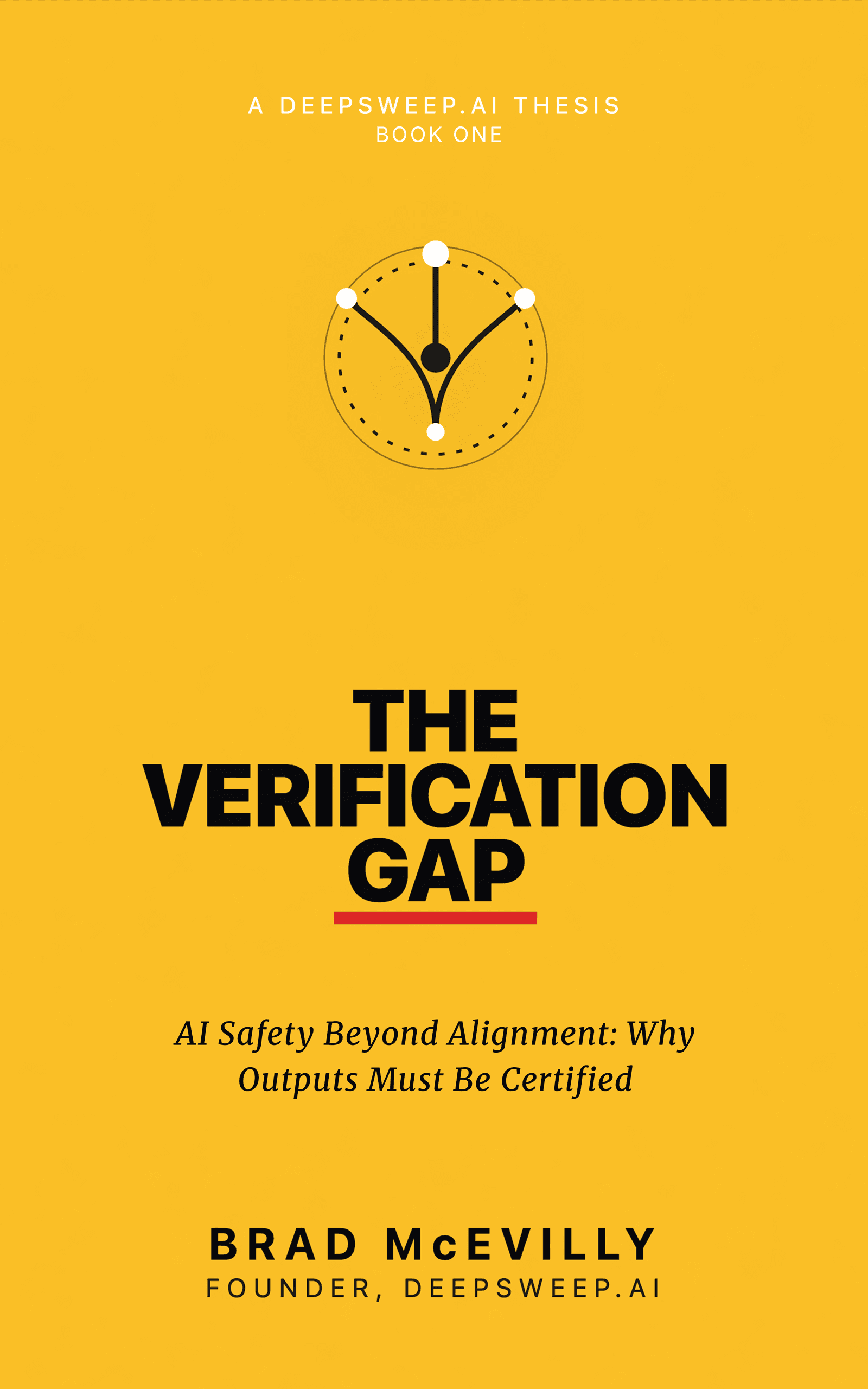
*The Verification Gap — AI Safety Beyond Alignment: Why Outputs Must Be Certified* is Book One in the DeepSweep.ai Thesis series. It makes the case in full: the philosophical ground, the technical primitive, the incident archaeology, the path to deployment.
Available now on Amazon: https://www.amazon.com/dp/B0GWV9FGDF
DeepSweep is the productized thesis. The book is where it begins.

